News

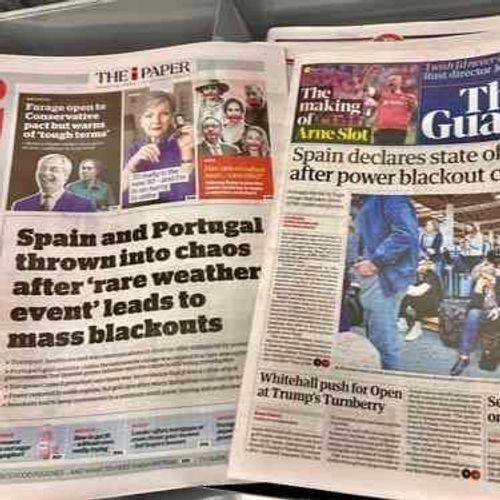
In the Dark: Diary of the 2025 Iberian Blackout
By David Innes-Edwards, Managing Director, Frontier Public Relations
I’m just old enough to remember life before the internet—but it took a total power grid failure across the Iberian Peninsula to remind me just how embedded electricity and connectivity have become in both our professional and personal lives.
It began on an otherwise typical Monday in Lisbon, where I was working remotely while my wife is based. At Frontier Public Relations, Mondays usually mean planning calls and client check-ins. I was midway through a Teams call when everything dropped: screen frozen, audio dead, internet gone. Annoying, but not unheard of.
That was 11:33 a.m.
A quick WhatsApp to my wife confirmed the same outage across town. Minutes later, the app failed too. Mobile signal vanished entirely. That’s when I knew this wasn’t just a localised fault. It felt different—bigger.
It was now 11:52 a.m.
I made my way to the roof terrace of the coworking space, where I saw an earnest pedestrian trying (and failing) to direct gridlocked traffic at a dead junction. Below, the city pulsed with confusion. Colleagues confirmed outages not just across Lisbon, but nationwide—and likely beyond.
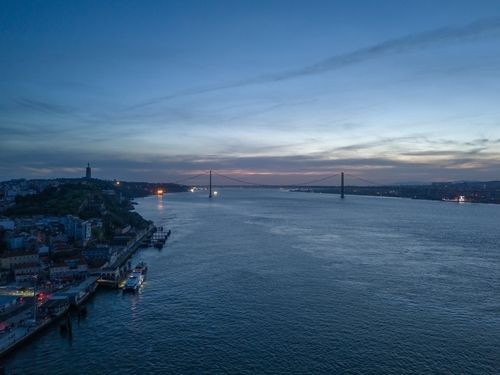

Despite my phone and laptop being fully charged, both were now functionally useless. No data. No calls. No comms. As someone who runs a PR consultancy dependent on real-time digital communication, I suddenly found myself professionally paralysed.
I couldn’t update clients, check in with staff, or even tell my wife—less than three kilometres away—what was happening.
As I walked home, the scope of the situation unfolded. Metro trains stalled in tunnels. The airport had shut. Lisbon’s iconic yellow trams were frozen mid-route, each one watched over by a stoic (and clearly bored) driver. Supermarkets had flipped back to a cash-only model—except, with ATMs down, no one could access any.
Most ATMs, I would later discover, power down seconds after losing grid connection unless they're backed by significant UPS systems or generators. Electronic point-of-sale terminals were similarly rendered useless. I was holding €18 in my pocket and suddenly felt like I’d struck gold.
At home by 1:25 p.m., my wife and neighbours confirmed that Spain was down too. In the absence of internet, mobile signal, or broadcast TV, speculation filled the void. Some blamed cyberattacks. One neighbour blamed Putin. The Portuguese, naturally, blamed Spain.
As a PR professional, I couldn’t help but reflect on how quickly a lack of verified information creates an information vacuum. Crisis communications theory tells us that in the absence of facts, rumours spread faster than any official update can hope to catch. But what happens when you can’t issue an update?
Later, when power returned, we’d learn the cause: a thick cloud formation over central Spain had suddenly dropped solar generation by 10GW in under two minutes. This sharp decline triggered automated emergency protection systems, shutting down high-voltage transmission lines and isolating entire regions. With dispatchable energy (like gas or hydro) unable to ramp up quickly enough, the grid collapsed.
In other words, I couldn’t work, couldn’t call my mother, and couldn’t pay for lunch—all because it got unexpectedly cloudy in Spain.
By 6 p.m., limited power was reportedly returning to some Spanish regions, but in Lisbon, we remained in the dark. At 7 p.m., we gave up, opened a bottle of red by candlelight, and leaned into the analogue life.
When the lights finally flickered back on at 11:30 p.m., I felt an odd mix of relief and anxiety. It had only been 12 hours, but the experience exposed just how brittle our dependency on interconnected infrastructure really is.
Professionally, I found it sobering. At Frontier PR, we work with businesses across the built environment, many of which are deeply embedded in the shift towards renewable energy. That transition is essential—but it also comes with new risks. This blackout was a reminder that clean energy needs robust infrastructure and careful planning to avoid cascading failures.
In the aftermath, I made a few changes: I bought an analogue radio, stashed some emergency cash, added power banks and candles to a drawer—and yes, kept another bottle of red nearby.
If this kind of event happens again—and I believe it will—we’ll need better systems, more resilient communication strategies, and clearer crisis protocols. For those of us in PR and communications, there’s a lesson here: we must plan not just for what we’ll say, but for how we’ll say it—when the internet isn’t an option.
A blog by David Innes-Edwards, Managing Director, Frontier Public Relations.
December, 29th December 2025